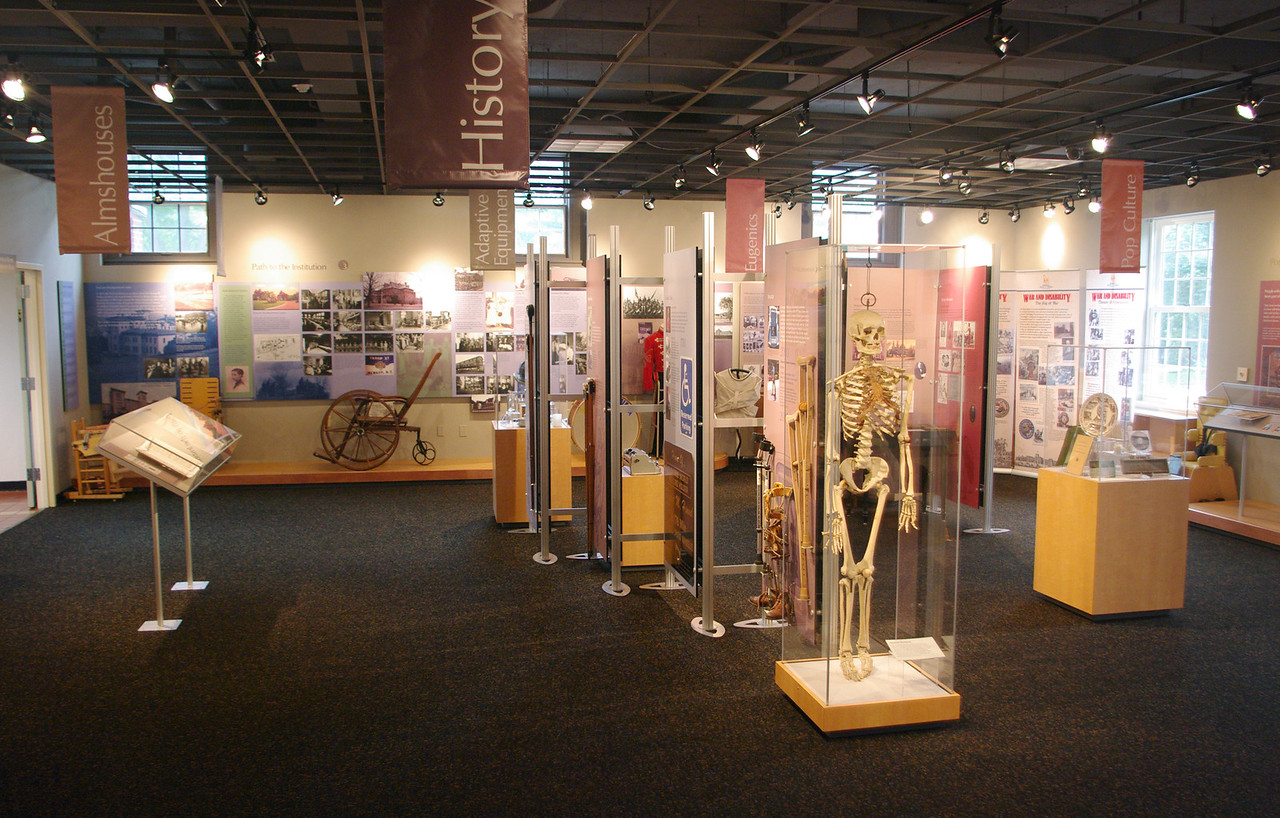
Welcome to the Cures for disABILITIES exhibit. Here you will find information on how society used different “cures” as a form or treatment for disabilities. The exhibit contains information on physical, educational, and pharmaceutical cures.


In order to cure disabilities, society has throughout time tried to identify the cause. From evil spirits to bad genetics, various techniques were used in an attempt to cure disabling conditions.
It was once thought that demons or evil spirits could cause disabilities such as mental illness and physical deformities.
The pull of the moon was also thought to be a cause for mental illness, hence, "Lunacy."
One method of letting the evil spirits out of the head was to cut a hole in the skull; this practice is known as trepanning.
As medical knowledge increased, superstitions about mental disabilities were replaced. The mind is seen as the seat of madness or idiocy.
When the New York State Asylum for Idiots in Syracuse opened in 1855, Idiocy was considered to be curable, and education was the answer.
The Spinning Treatment was one of many treatments that attempted to rid the body of mental illness through physical means. Other practices included bloodletting, purging, blistering, and frightening the patient.
The Spread Eagle Cure was used to treat disorderly patients. Cold water was poured from a height over the persons face until the patient is "calm"
Water continued to be seen as a viable treatment in the 1940s: this is a hydrotherapy room in a Mental institution.
Mild electric shock was used to stimulate the muscles and the mind in this 19th century cure for mental illness known as Faradization.
Electroconvulsive Therapy was used for treatment of mental illness, including depression (photo circa 1940s.)
The frontal lobe lobotomy, performed here by Dr. Walter Freeman, gained popularity as an effective treatment for mental illness in the 1940s.

Some cures for disabilities such as epilepsy contained alcohol and opium and were sold to the general public.
Ida McKinley (1847-1907) experienced seizures while she was First Lady, bromides and laudanum (opium and alcohol) were part of her treatment.
Prescriptions like Luminal were specific for epilepsy and no longer contained opium. Phenobarbital, a barbiturate is the active ingredient in Luminal.
Anticonvulsant medications were developed over time to be less habit forming and more effective.
Telethons have been utilized to raise money for research for various disabling conditions, such as muscular dystrophy.
Public awareness campaigns like The National Foundation For Infantile Paralysis helped to raise funds for research. Later it is known as the March of Dimes. Dr. Jonas Salk would develop a vaccine that would address this public health threat.
Entertainers like Sonny and Cher, and Henry Fonda have used their celebrity to promote research, and a search for a cure for CP.
A horse riding accident resulted in a spinal cord injury that paralyzed this actor , best known for his role of "Superman." He would then found the Christopher Reeve Foundation devoted to finding a cure for SCI.
The new medical and scientific frontier for cures for disabilities is at the gene and chromosome level. Testing for predisposition for disease, or in utero testing can now tell us about potential disabling conditions.
