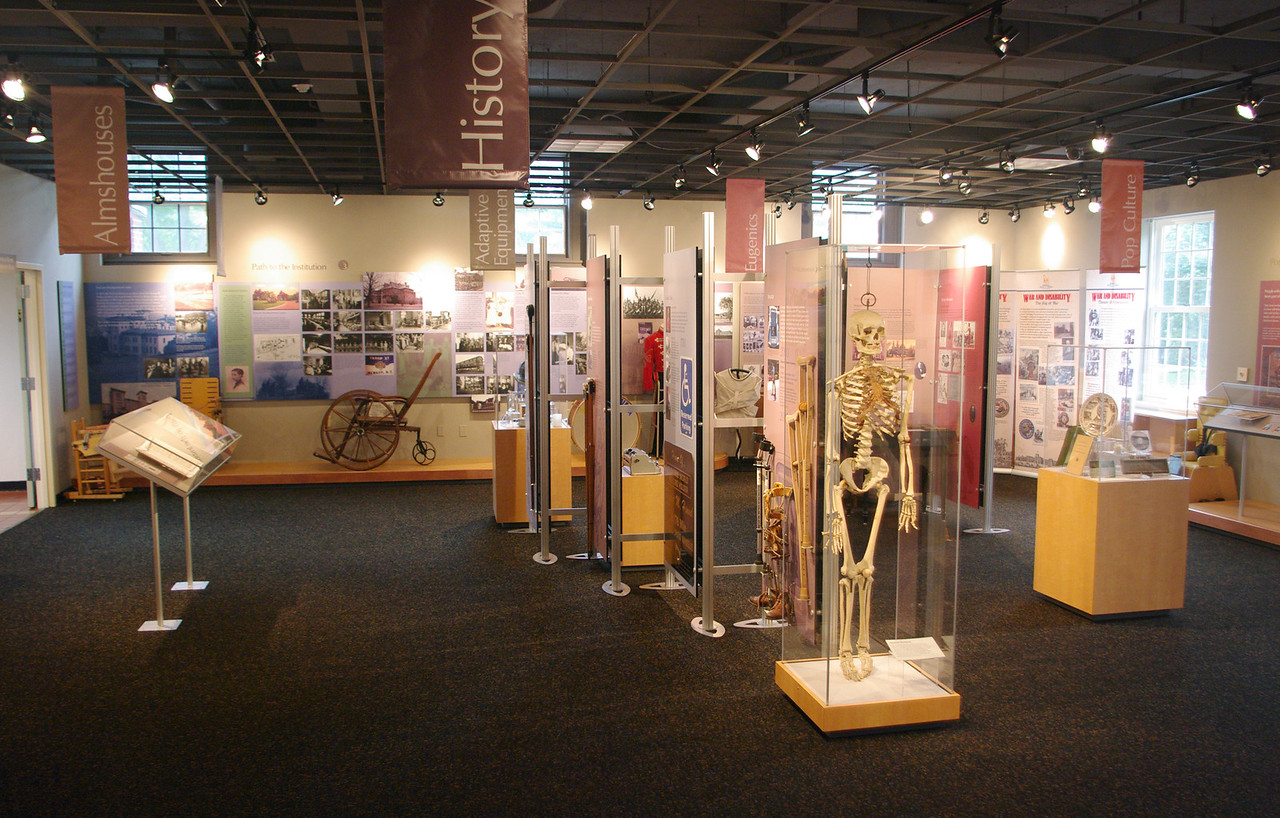
Welcome to the Prevention of disABILITIES exhibit. Here you will find information on ideas that were historically thought of as a form of prevention of disabilities. These ideas include Eugenics, the fight against Polio, Newborn Screening, Preventing Mental Retardation, Vaccines, and Nutrition.

Considered a form of "prevention," especially during its peak from about 1907 and into the 1960s, eugenic ideals such as segregation and sterilization were employed against "imbeciles" and supposed "defectives."
In 1927, the United States Supreme Court upheld compulsory sterilization of the "unfit" in Buck v. Bell.
The Eugenics Movement sought to strengthen society by encouraging people with a "goodly heritage" to bear children while those with a history of "defectives" in the family were discouraged from reproducing.
In the 1930s, the fight against infantile paralysis, or polio, became a national initiative.
The National Foundation for Infantile Paralysis was created in 1937 by President Franklin Roosevelt. A year later it became the March of Dimes.
In 1948, John Franklin Enders, Thomas Huckle Weller, and Franklin Chapman Robbins discovered a process to grow the polio virus in a laboratory.
The process led to development of the first polio vaccine by Jonas Salk. Administered by a series of injections, the vaccine was tested in 1952 and made public in 1955.
In 1958, Dr. Albert Sabin developed the oral polio vaccine. Sabin's vaccine prevented infection and paralysis from poliomyelitis.
Here is an example of an immunization certificate and the modern form of the oral polio vaccine.
Screening for potential diseases that could lead to developmental disabilities began in the 1960s when Dr. Robert Guthrie developed a mass screening test for phenylketonuria.
Newborn screening allows for the early detection and possible treatment of potential disabilities. Many states have made the testing mandatory.

There are several things that can be done to prevent mental retardation and developmental disabilities.
This chart from Henry Herbert Goddard's Feeble-Mindedness: Its Causes and Consequences shows the relationship of alcohol and mental deficiency.
Improved health care and the vaccination against rubella, measles as well as other diseases has prevented cases of mental retardation.
The first rubella vaccines were developed in 1969. One was later combined with the measles and mumps vaccine (MMR) in 1972.
Improving nutrition in both the pregnant mother and a newborn baby is a preventative measure against developmental disabilities.
Before and during pregnancy, it is important for the expecting mother to have enough folic acid in her diet. Folic acid prevents birth defects of the brain and spinal chord.
